
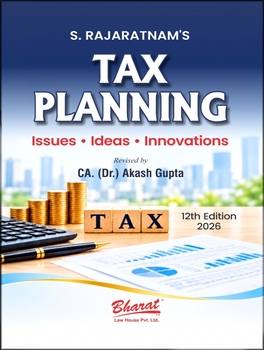
Tax Planning (12th edition, 2026)
- Year of Publication: 2026
- Edition: 12th
- ISBN: 978-81-69449-93-9
- No.of Pages: 2261
A book reaches its twelfth edition only if readers keep coming back to it. They have come back to Tax Planning for one reason above all: it was never a book about saving tax by trick. S. Rajaratnam built it on a simple belief — that tax is a cost, that a cost can be managed, and that the only management worth the name is the kind that still holds good when an officer, a Tribunal or a High Court looks at the transaction years after it was made. Every edition since the first has tried to live up to that belief. This one is no different, though almost everything around it has changed.
The Income-tax Act, 2025, read with the Income-tax Rules, 2026 and amended in its very first year by the Finance Act, 2026, is now the law. The new Act is not merely a renumbering. It gives us a single “tax year” in place of the familiar pair of previous year and assessment year; it moves the exemptions into Schedules; it gathers into one place provisions that the old Act had scattered — on charitable institutions, on deduction and collection of tax at source, on assessments after a search; and it makes the default regime, with its rebate, the starting point of every individual’s computation.
A planning book that went on speaking the language of 1961 would have become a history book within a year. So nothing in this edition has been left as it was. Every chapter has been read again against the 2025 Act, the 2026 Rules and the Finance Act, 2026, and rewritten wherever the law, the rates, the limits or the forms have moved.
What the reader will find
Statements of the present law cite the sections of the 2025 Act. Where it helps, the old section number is given beside it, because practitioners will be working under both Acts for some years — the assessment year 2026-27 and every pending assessment, reassessment and appeal still belong to the 1961 Act. Judicial decisions have been treated differently, and deliberately so. A court decides the provision that was before it. To renumber that provision inside the holding would misstate what the court held. Decisions are therefore reported withthe sections under which they were decided, and the text points to the corresponding provision of the new Act wherever the principle continues to apply. Every decision discussed in the book is cited in a footnote on the page where it appears, so that the reader does not have to leave the page to find it.
The worked illustrations in the “Consultant’s Desk” have been recomputed under the new law. Chapter 1 analyses the Finance Act, 2026, the first Finance Act on the new Act. Chapters on schemes that are no longer open — the Settlement Commission, the Vivad se Vishwas schemes, wealth-tax, the Pradhan Mantri Garib Kalyan Yojana — have been kept as historical reference, because matters under them are still being decided and the principles they produced still shape how the new law is read. Where the law is unsettled, the book says so rather than pretending otherwise.
The approach to planning
The new law has changed the arithmetic of planning as much as its vocabulary. The default regime and the rebate alter the value of several devices that earlier editions could take for granted — the Hindu undivided family, the dispersal of income within a family, the private trust. Each has been examined afresh in that light. The general anti-avoidance rule, the principal purpose test in our treaties and the courts’ recent approach to treaty claims have all narrowed the room for arrangements that have no commercial substance.
This book therefore recommends only such planning as rests on real transactions, carried out at the source of the income and supported by documents made at the time. It does not recommend, and warns against, sham arrangements, circular movement of funds and backdated papers. Those do not save tax. They postpone the dispute and add penalty and prosecution to it. That was the founding author’s position, and it is mine.
S.RAJARATNAM, M.A., LL.M., F.I.C.W.A., after a brief spell as a lecturer in Economics joined Indian Revenue Service, rose to the position of Commissioner of Income Tax and retired as Accountant Member, Income-tax Appellate Tribunal in 1985. During service, he was deputed to Sri Lanka as Taxation Expert in 1960-62 and to the Government of Tamil Nadu as Member, Tamil Nadu Sales-tax and Agricultural Income-tax Appellate Tribunal during 1971-76. He is a Fellow Member of the Institute of Cost Accountants of India and a Life Member of the Indian Law Institute. He is presently having chamber practice as an Advocate & Tax Consultant and is Honorary Director (Education & Research), Society of Auditors, Chennai. He is a regular participant in seminars and workshops conducted by professional institutions. He is a prolific writer contributing to various tax journals and in the editorial Board of Current Tax Reporter, Jodhpur and Modern Rationalist, Chennai.
He has authored and co-authored several books on topical subjects with the present publisher, Bharat Law House Pvt. Ltd., New Delhi like Voluntary Disclosure Scheme, Kar Vivad Samadhan Scheme, Concession for Foreign Exchange Earners, Deduction for Industries in Backward Districts and Search and Seizure. His book on “Tax Planning” is published by Bharat Law Publications, Jaipur jointly with LexisNexis India, Delhi. His books Treatise on Double Tax Avoidance Agreement, Law and Procedure on Charitable Trusts and Religious Institutions and MAT are published by Snow White Publications, Mumbai. The Bookss titled ‘Landmark Cases’, Corporate Taxation, Tax Management, Tax Valuation, Tax Audit Report, Post-search Assessments, Income Tax Prosecution, Black Money Act and Transfer Pricing are published by Company Law Institute of India Pvt. Ltd., Chennai.
Bharat is a 'trade-name' for a group of concerns, popularly known as Bharat Law House and Bharat Law House Pvt. Ltd. Bharat is one of the most reputed publishers of law books with an experience of over six decades. It possess a very diverse range of publications covering not only the area of taxation - direct and indirect - but also company law, insolvency capital market, finance, industrial law, foreign exchange, commercial, civil and criminal laws. The students publications for CA, CS, CMA, CFA, MBA, graduate and post-graduate studies have carved out a niche for themselves. The Publication House has a professionally qualified team with strong in-house capabilities. Their strength lies in the patronage of legal luminaries in every field. They strive for accuracy, authenticity and sincerity.
Similar Books
Ratings and Reviews
Overall Rating
- Year of Publication: 2026
- Edition: 12th
- ISBN: 978-81-69449-93-9
- No.of Pages: 2261
A book reaches its twelfth edition only if readers keep coming back to it. They have come back to Tax Planning for one reason above all: it was never a book about saving tax by trick. S. Rajaratnam built it on a simple belief — that tax is a cost, that a cost can be managed, and that the only management worth the name is the kind that still holds good when an officer, a Tribunal or a High Court looks at the transaction years after it was made. Every edition since the first has tried to live up to that belief. This one is no different, though almost everything around it has changed.
The Income-tax Act, 2025, read with the Income-tax Rules, 2026 and amended in its very first year by the Finance Act, 2026, is now the law. The new Act is not merely a renumbering. It gives us a single “tax year” in place of the familiar pair of previous year and assessment year; it moves the exemptions into Schedules; it gathers into one place provisions that the old Act had scattered — on charitable institutions, on deduction and collection of tax at source, on assessments after a search; and it makes the default regime, with its rebate, the starting point of every individual’s computation.
A planning book that went on speaking the language of 1961 would have become a history book within a year. So nothing in this edition has been left as it was. Every chapter has been read again against the 2025 Act, the 2026 Rules and the Finance Act, 2026, and rewritten wherever the law, the rates, the limits or the forms have moved.
What the reader will find
Statements of the present law cite the sections of the 2025 Act. Where it helps, the old section number is given beside it, because practitioners will be working under both Acts for some years — the assessment year 2026-27 and every pending assessment, reassessment and appeal still belong to the 1961 Act. Judicial decisions have been treated differently, and deliberately so. A court decides the provision that was before it. To renumber that provision inside the holding would misstate what the court held. Decisions are therefore reported withthe sections under which they were decided, and the text points to the corresponding provision of the new Act wherever the principle continues to apply. Every decision discussed in the book is cited in a footnote on the page where it appears, so that the reader does not have to leave the page to find it.
The worked illustrations in the “Consultant’s Desk” have been recomputed under the new law. Chapter 1 analyses the Finance Act, 2026, the first Finance Act on the new Act. Chapters on schemes that are no longer open — the Settlement Commission, the Vivad se Vishwas schemes, wealth-tax, the Pradhan Mantri Garib Kalyan Yojana — have been kept as historical reference, because matters under them are still being decided and the principles they produced still shape how the new law is read. Where the law is unsettled, the book says so rather than pretending otherwise.
The approach to planning
The new law has changed the arithmetic of planning as much as its vocabulary. The default regime and the rebate alter the value of several devices that earlier editions could take for granted — the Hindu undivided family, the dispersal of income within a family, the private trust. Each has been examined afresh in that light. The general anti-avoidance rule, the principal purpose test in our treaties and the courts’ recent approach to treaty claims have all narrowed the room for arrangements that have no commercial substance.
This book therefore recommends only such planning as rests on real transactions, carried out at the source of the income and supported by documents made at the time. It does not recommend, and warns against, sham arrangements, circular movement of funds and backdated papers. Those do not save tax. They postpone the dispute and add penalty and prosecution to it. That was the founding author’s position, and it is mine.
S.RAJARATNAM, M.A., LL.M., F.I.C.W.A., after a brief spell as a lecturer in Economics joined Indian Revenue Service, rose to the position of Commissioner of Income Tax and retired as Accountant Member, Income-tax Appellate Tribunal in 1985. During service, he was deputed to Sri Lanka as Taxation Expert in 1960-62 and to the Government of Tamil Nadu as Member, Tamil Nadu Sales-tax and Agricultural Income-tax Appellate Tribunal during 1971-76. He is a Fellow Member of the Institute of Cost Accountants of India and a Life Member of the Indian Law Institute. He is presently having chamber practice as an Advocate & Tax Consultant and is Honorary Director (Education & Research), Society of Auditors, Chennai. He is a regular participant in seminars and workshops conducted by professional institutions. He is a prolific writer contributing to various tax journals and in the editorial Board of Current Tax Reporter, Jodhpur and Modern Rationalist, Chennai.
He has authored and co-authored several books on topical subjects with the present publisher, Bharat Law House Pvt. Ltd., New Delhi like Voluntary Disclosure Scheme, Kar Vivad Samadhan Scheme, Concession for Foreign Exchange Earners, Deduction for Industries in Backward Districts and Search and Seizure. His book on “Tax Planning” is published by Bharat Law Publications, Jaipur jointly with LexisNexis India, Delhi. His books Treatise on Double Tax Avoidance Agreement, Law and Procedure on Charitable Trusts and Religious Institutions and MAT are published by Snow White Publications, Mumbai. The Bookss titled ‘Landmark Cases’, Corporate Taxation, Tax Management, Tax Valuation, Tax Audit Report, Post-search Assessments, Income Tax Prosecution, Black Money Act and Transfer Pricing are published by Company Law Institute of India Pvt. Ltd., Chennai.
Bharat is a 'trade-name' for a group of concerns, popularly known as Bharat Law House and Bharat Law House Pvt. Ltd. Bharat is one of the most reputed publishers of law books with an experience of over six decades. It possess a very diverse range of publications covering not only the area of taxation - direct and indirect - but also company law, insolvency capital market, finance, industrial law, foreign exchange, commercial, civil and criminal laws. The students publications for CA, CS, CMA, CFA, MBA, graduate and post-graduate studies have carved out a niche for themselves. The Publication House has a professionally qualified team with strong in-house capabilities. Their strength lies in the patronage of legal luminaries in every field. They strive for accuracy, authenticity and sincerity.
